The Sand Outside Beachfront Isn't Coming Back On Its Own This Year
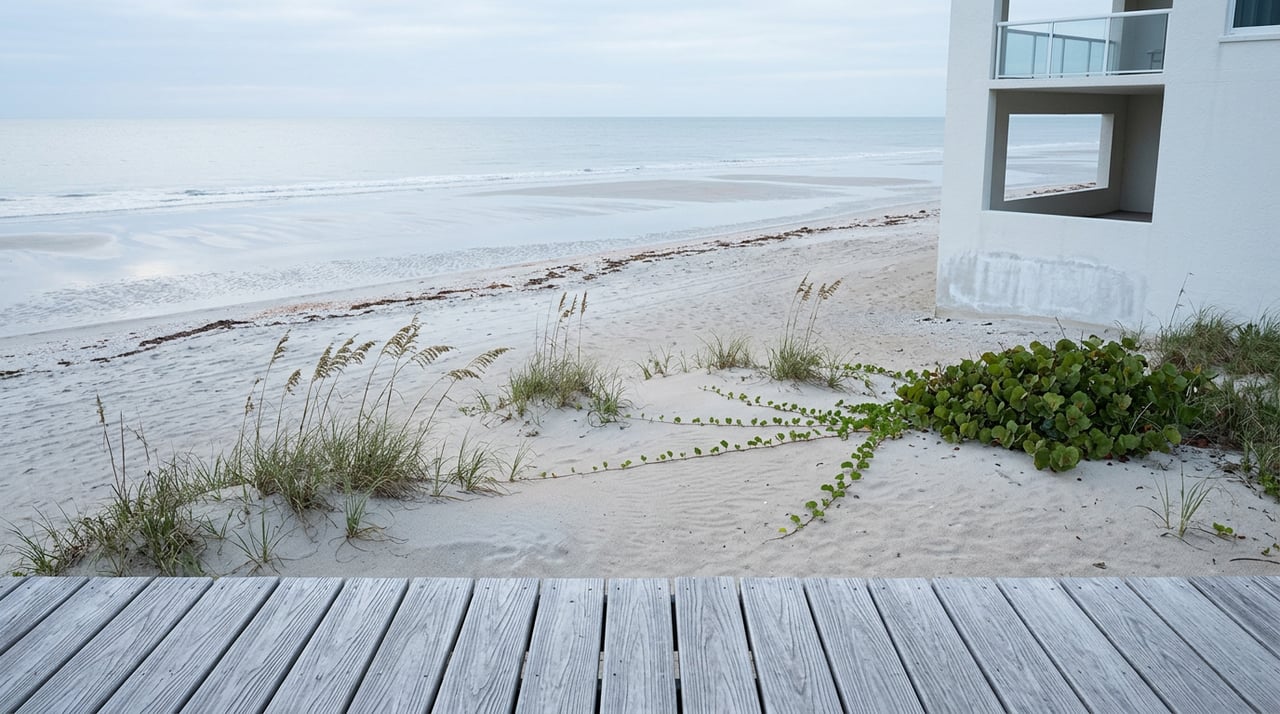
Walk the beach in front of Beachfront at Singer Island at high tide this month and you'll notice something that wasn't true a few winters ago: the water reaches farther up the sand than it used to, and in spots it's close enough to touch the seawall. That's not a trick of the light or a bad tide table day. It's the visible result of a fight between Riviera Beach and Palm Beach County that's been building for years and finally broke into public view this summer.
The short version is this: the county hasn't added sand to this stretch of shoreline in two winters, and it isn't planning to this year either. So in May, the city stopped waiting and started paying for the work itself.
The city set aside $77,000 in May 2026 to hire Baird, a West Palm Beach-based coastal engineering firm, to design an emergency dune-replacement project and chase down a state permit to move fast. The target area runs 1.2 miles, from the Cote D'Azur condominiums just north of Ocean Reef Park up to Water Glades, the northernmost building on the island. Beachfront sits inside that stretch.
The full project could cost as much as $6 million. That's a real number, but it's worth putting next to another one: since 2001, Palm Beach County and its partners have spent more than $21.7 million restoring dunes along roughly 1.3 miles of Singer Island's shoreline, a nearly identical footprint to the one now in question. This isn't new terrain. It's a beach the county has funded before, at scale, for two decades. What changed is that the money stopped showing up.
City Council Member Glen Spiritis, who represents Singer Island, doesn't buy the county's timing. He's pointed out that the county operates on a $9.5 billion annual budget and argues the cost of doing right by this stretch of coast is a rounding error by comparison. "I find it hard to believe that $1.7 million is going to break them," he said. Whether that specific figure lines up with the full project cost or a narrower ask for state matching funds, the point he's making is about scale: a county this size choosing not to fund a beach that residents, by his account, protect for the mainland as much as for themselves.
Palm Beach County didn't just decline quietly. In a 16-page response to a petition from residents, the county's Department of Environmental Management laid out its reasoning, and one line stands out. Among the reasons listed for declining short-term restoration: difficult access to the beach caused by private seawall construction on Singer Island condominiums.
That's a detail that changes how you read everything else. The seawalls that individual buildings have built over the years to hold their own ground against the ocean are, according to the county, part of what's making it harder to get equipment and sand onto this beach at all. In 2025, the city managed to place sand on about 500 yards of shoreline near the Seawinds and Via Delfino condominiums before county crews stopped midway through, citing exactly this combination of seawalls and tidal conditions.
"I love my home and I want to protect it."
That's Sue Melamud, an environmental engineer and Singer Island resident who has been one of the loudest voices pushing the county to act. She and fellow resident Frank Fernandez co-chair the Singer Island Environmental Committee, which started collecting signatures for a petition back in 2024 and delivered them to county commissioners this past March. Their written appeal to commissioners put it plainly: residents are "very concerned, disappointed, and disheartened" that the county hasn't honored what they describe as a 10-year interlocal agreement to keep sand on this beach. The county's position is that the agreement doesn't legally require it.
Melamud has also flagged a quieter cost of the erosion that has nothing to do with dollars. She says the nesting turtle population on this stretch has seen a distinct drop as the beach narrows and the high-tide line creeps closer to the seawalls. Late summer is typically the tail end of nesting season on this coast, which makes this month a fitting time to notice just how little dry sand is left for it.
What's actually happening right now on Singer Island's north end is really two separate efforts moving on two separate clocks, run by two different engineering teams answering to two different governments.
| City's Emergency Project | County's Long-Term Study | |
|---|---|---|
| Engineer | Baird | Foth |
| Funded by | Riviera Beach, $77,000 design contract | Palm Beach County |
| Scope | 1.2 miles, Cote D'Azur to Water Glades | Structural solutions across the same corridor |
| Approach | Sand placement, expedited state permit | T-head groins, low-profile groins, breakwaters, segmented breakwaters |
| Timeline | Design and permitting underway as of this summer, no construction start date announced | At least five years of study, dependent on state and federal permitting |
Foth's lead on the county side, engineer Steve Howard, presented these structural options to residents at a gathering at the Marina Village Event Center in December 2025, walking through the tradeoffs between cost, stability, and how likely each option is to actually get permitted. That's the slow track. It's the kind of project that, if it happens at all, is still years out.
The city's project is the fast track, and it's the one that matters more immediately for anyone walking this beach in the coming months. As of this writing, Riviera Beach has the design contract in hand and is working toward a state permit, but no construction start date has been announced. The gap between "we've hired an engineer" and "trucks are on the sand" is where things stand right now.
It's worth being specific about where Beachfront sits in all of this. The affected corridor isn't an abstract description of "Singer Island's beaches." It's a named 1.2-mile run of coast with a start point at Cote D'Azur, just north of Ocean Reef Park, and an end point at Water Glades. Beachfront's address places it inside that boundary, not adjacent to it. Whatever happens with sand placement, permitting delays, or the eventual choice between groins and breakwaters happens on the same stretch of beach that residents here walk every morning.
That's also why the county's seawall comment lands differently once you know where you live. The protective structures that give oceanfront buildings on this stretch a measure of security against storm surge are, by the county's own account, part of what makes large-scale sand restoration harder to execute here than in places without that kind of shoreline armoring. Nobody set out to create that tradeoff. It's just where two decades of individual building decisions and one long-running government dispute happen to intersect, right along this particular run of coast.
For now, the practical reality is unchanged from what you can see on your own walk: less beach at high tide than there used to be, waves reaching closer to the seawalls, and a visible gap where two winters of sand should have been. The city has committed money and hired an engineer, which is more than happened the previous two years combined. Whether that turns into trucks and sand on this specific stretch before the next high tide season is still an open question, and one worth watching rather than assuming.
If you're curious about how any of this touches your building specifically, or you just want someone local who's been tracking it, Kathy Lewellen knows this stretch of coast building by building. Request Your Home Valuation & Market Consultation and she'll walk you through what's actually happening on the ground here, not just what's in the headlines.

Get assistance in determining current property value, crafting a competitive offer, writing and negotiating a contract, and much more. Contact her today.